1. Introduction
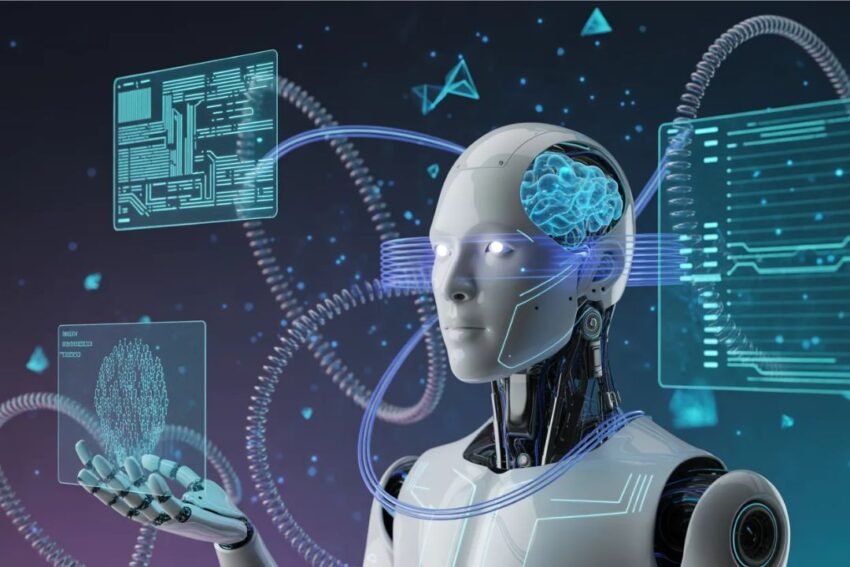
Artificial Intelligence (AI) refers to the simulation of human intelligence in machines programmed to think, learn, and perform tasks that typically require human cognition. Over the past few decades, AI has evolved from theoretical concepts to practical applications that permeate industries, healthcare, communication, and everyday life. Its rapid development is reshaping economies, cultures, and the future of work.
2. History of Artificial Intelligence
2.1 Early Concepts
The idea of artificial beings dates back to ancient myths, where mechanical automata were imagined in Greek and Egyptian mythology. Philosophers and inventors speculated about creating thinking machines long before the technology existed.
2.2 The Birth of Modern AI
- 1950s: Alan Turing introduced the concept of machine intelligence and the famous Turing Test to evaluate whether machines can exhibit intelligent behavior.
- 1956: John McCarthy coined the term “Artificial Intelligence” at the Dartmouth Conference, marking the formal beginning of AI as a field of study.
2.3 Evolution Through the Decades
- 1960s–1970s: Development of early AI programs such as ELIZA (a natural language processor).
- 1980s: Expert systems became popular in business decision-making.
- 1990s–2000s: AI shifted towards machine learning and data-driven approaches.
- 2010s–present: Deep learning and neural networks enabled breakthroughs in computer vision, natural language processing, and autonomous systems.
3. Types of Artificial Intelligence
AI can be classified in multiple ways based on capability and functionality.
3.1 Based on Capability
- Narrow AI (Weak AI): Focused on specific tasks, e.g., virtual assistants like Siri or Alexa.
- General AI (Strong AI): Aims to perform any intellectual task a human can. Still largely theoretical.
- Superintelligent AI: A hypothetical AI surpassing human intelligence in all aspects.
3.2 Based on Functionality
- Reactive Machines: No memory; only respond to current inputs (e.g., IBM’s Deep Blue).
- Limited Memory: Can use past experiences to inform decisions (e.g., self-driving cars).
- Theory of Mind: Machines understanding human emotions and intentions (emerging research).
- Self-aware AI: Machines with consciousness and self-awareness (currently speculative).
4. Core Technologies in AI
- Machine Learning (ML): Algorithms that allow systems to learn from data without explicit programming.
- Deep Learning (DL): A subset of ML using neural networks to model complex patterns.
- Natural Language Processing (NLP): Enables machines to understand and generate human language.
- Computer Vision: Allows AI to interpret visual information from the world.
- Robotics: Integration of AI in machines that perform physical tasks.
5. Applications of Artificial Intelligence
5.1 Healthcare
- AI aids in diagnostics, personalized treatment, drug discovery, and robotic surgeries.
- Predictive analytics helps in identifying disease outbreaks and patient risk factors.
5.2 Business and Industry
- AI optimizes supply chains, improves customer service with chatbots, and enhances data-driven decision-making.
- Predictive maintenance in manufacturing reduces downtime and increases efficiency.
5.3 Transportation
- Autonomous vehicles use AI for navigation, obstacle detection, and traffic management.
- AI-driven logistics streamline deliveries and route optimization.
5.4 Education
- Personalized learning systems adapt content to student needs.
- AI tutors provide interactive support and assessment tools.
5.5 Entertainment and Creativity
- AI generates music, artwork, and even scripts.
- Recommendation systems (like Netflix and Spotify) tailor content to user preferences.
6. Ethical and Social Considerations
- Bias and Fairness: AI systems can inherit biases from training data, leading to unfair outcomes.
- Job Displacement: Automation may replace certain jobs while creating new ones.
- Privacy Concerns: AI systems can process vast amounts of personal data.
- AI Governance: Policies are needed to ensure responsible development and deployment.
7. Future of Artificial Intelligence
- Human-AI Collaboration: Enhanced productivity and creative partnerships.
- Explainable AI (XAI): AI that can explain its reasoning to humans.
- AI in Climate Solutions: Predictive models for weather, resource management, and sustainability.
- Quantum AI: Potential to revolutionize computing speed and problem-solving capabilities.
FAQs About Artificial Intelligence
1. What is Artificial Intelligence (AI)?
Artificial Intelligence is the simulation of human intelligence in machines that are programmed to think, learn, and perform tasks typically requiring human cognition. AI systems can analyze data, recognize patterns, and make decisions.
2. What are the main types of AI?
AI is broadly categorized into:
- Narrow AI (Weak AI): Designed for specific tasks like voice assistants.
- General AI (Strong AI): Hypothetical AI capable of performing any human intellectual task.
- Superintelligent AI: Future AI surpassing human intelligence across all areas (speculative).
3. How is AI used in everyday life?
AI powers technologies like:
- Smartphone assistants (Siri, Google Assistant)
- Recommendation engines (Netflix, YouTube)
- Autonomous vehicles and smart home devices
- Healthcare diagnostics and predictive analytics
4. What are the challenges of AI?
- Ethical concerns (bias, privacy)
- Job displacement and economic impact
- Security risks and AI misuse
- Lack of transparency in decision-making (the “black box” problem)
5. What is the future of AI?
The future of AI includes human-AI collaboration, explainable AI, AI-driven climate solutions, advancements in healthcare, and potential breakthroughs with quantum computing. Ensuring responsible development and governance will be key.
6. Can AI think and feel like humans?
Currently, AI cannot experience emotions, consciousness, or self-awareness. It can simulate certain aspects of human behavior, but genuine understanding and emotion remain uniquely human.
Conclusion
Artificial Intelligence is one of the most transformative technologies of the 21st century. From healthcare and education to business and entertainment, AI is shaping the way we live, work, and interact. While the opportunities are enormous—boosting productivity, enabling innovation, and solving complex global challenges—AI also brings ethical, social, and technical challenges that cannot be ignored.